3/5/22 Solar Report

Tad Cook, K7RA, Seattle, reports: Solar activity was weak over the February 24 – March 2 reporting week with average daily sunspot numbers weakening from 54.3 to 44, but average daily solar flux rising slightly from 95.4 to 98.3.

Geomagnetic numbers were moderate. Average daily planetary A index declined from 9.6 to 7.3, and the middle latitude index from 7.3 to 5.6.

Predicted solar flux is 115 on March 3 – 4; 110 on March 5 – 6; 105 on March 7; 100 on March 8 – 10; 99 on March 11 – 13; 98 on March 14; 95 on March 15 – 16; 96, 97, 98, and 99 on March 17 – 20; 100 on March 21 – 22; 101 and 100 on March 23 – 24; 102 on March 25 – 26; 99 and 102 on March 27 – 28; 105 on March 29 – 31; 102 on April 1 – 2; 101 on April 3 – 4, and 100 on April 5 – 6.

Predicted planetary A index is 5, 8, 12, and 8 on March 3 – 6; 5 on March 7 – 10; 15, 12, 8, 5, and 8 on March 11 – 15; 5 on March 16 – 17; 10 on March 18; 15 on March 19 – 21; 7 on March 22 – 24; 5 and 10 on March 25 – 26; 12 on March 27 – 28; 8 on March 29 – 30; 12 on March 31; 15 on April 1 – 2, and 5 on April 3 – 6.

Sunspot numbers for February 24 – March 2 were 23, 22, 22, 48, 65, 62, and 66, with a mean of 44. The 10.7-centimeter flux was 92.3, 96.2, 96.5, 96.9, 99, 99.3, and 109.5, with a mean of 98.5. Estimated planetary A indices were 7, 8, 3, 13, 8, 8, and 4, with a mean of 7.3. Middle latitude A index was 6, 7, 1, 11, 5, 6, and 3, with a mean of 5.6.

A comprehensive K7RA Solar Update is posted Fridays on the ARRL website. For more information concerning radio propagation, visit the ARRL Technical Information Service, read “What the Numbers Mean…,” and check out the Propagation Page of Carl Luetzelschwab, K9LA.

A propagation bulletin archive is available. For customizable propagation charts, visit the VOACAP Online for Ham Radio website.

Share your reports and observations.

SeaPac info

  • SEA-PAC 2022 online registration has been delayed due to technical difficulties restarting the registration web pages. SEA-PAC anticipates that online Registration will open on March 7 at 6 PM Pacific Time. SEA-PAC 2022 will host the ARRL Northwestern Division Convention June 3 – 5. The 2022 SEA-PAC QSO Party is being planned for the weekend before the event.

Solar Report 2-24-22

Tad Cook, K7RA, Seattle, reports: New sunspot groups appeared on February 17, 19, 20, and 21, but solar activity declined, even though sunspots were covering the sun every day.

The average daily sunspot number declined by 21 points, from 75.3 last week to 54.3 in the February 17-23 reporting week. Average daily solar flux was down by nearly 15 points, from 110.1 to 95.4.

The average daily planetary A index went from 13 to 9.6, and the average daily middle latitude A index was off by a point to 7.3.

Predicted solar flux is 100 on February 24; 105 on February 25 – March 2; 110 on March 3 – 4; 108 on March 5 – 8; 105 on March 9 – 11; 103 on March 12 – 13; 100 on March 14; 98 on March 15 – 16; 102 on March 17 – 19; 104 on March 20 – 22; 108 on March 23 – 26; 110 on March 27; 115 on March 28 – 29, then 112 and 110 on March 30 – 31.

Predicted planetary A index is 5 on February 24 – 25; 10 on February 26; 8 on February 27 – March 2; 12, 15, 10, and 8 on March 3 – 6; 5 on March 7 – 10; 15, 12, and 10 on March 11 – 13; 5 on March 14 – 18; then 8, 5, 12, 18, 15, and 10 on March 19 – 24; 5 on March 25 – 29, and 12, 15, 10, and 8 on March 30 – April 2.

Sunspot numbers for February 17 – 23 were 103, 53, 51, 49, 48, 38, and 38, with a mean of 54.3. The 10.7 – centimeter flux was 96.7, 93.3, 95.7, 93.3, 97.8, 95.3, and 95.5, with a mean of 95.4. Estimated planetary A indices were 5, 6, 9, 13, 12, 16, and 6, with a mean of 9.6. Middle latitude A index was 4, 5, 6, 8, 11, 13, and 4, with a mean of 7.3.

A comprehensive K7RA Solar Update is posted Fridays on the ARRL website. For more information concerning radio propagation, visit the ARRL Technical Information Service, read “What the Numbers Mean…,” and check out the Propagation Page of Carl Luetzelschwab, K9LA.

A propagation bulletin archive is available. For customizable propagation charts, visit the VOACAP Online for Ham Radio website.

Share your reports and observations.
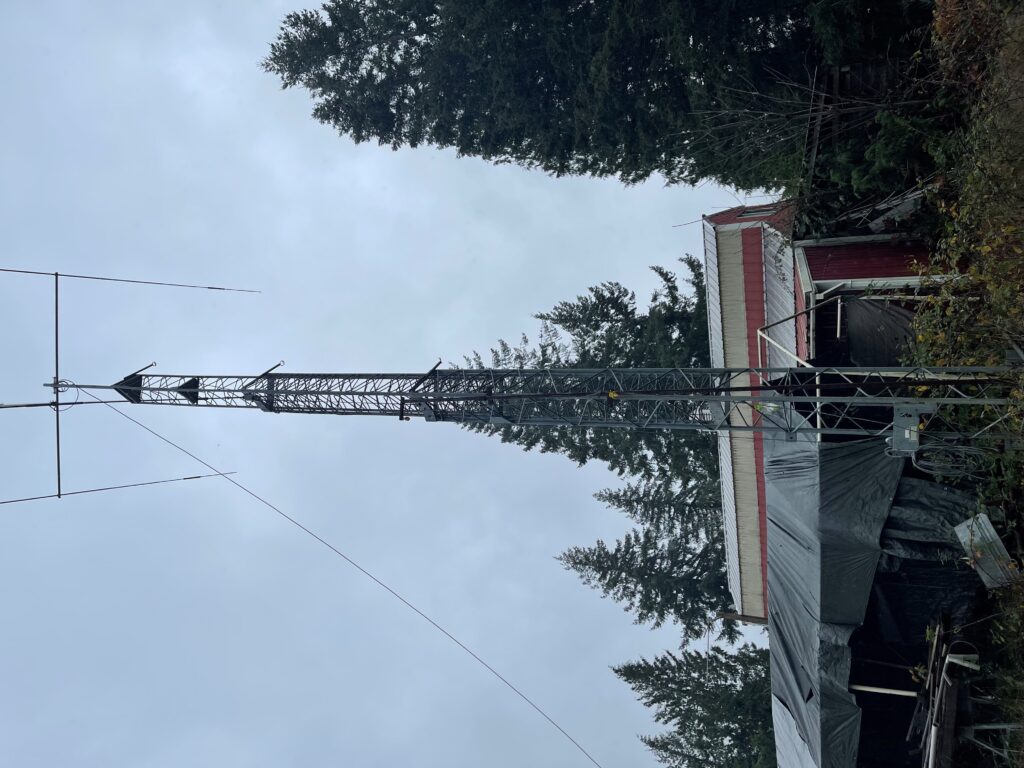
Tower and antenna for sale

Click here to contact Jeremy AG7WT for details.

Tad Cook Report 2-17-22

Tad Cook, K7RA, Seattle, reports: Although solar activity was generally lower this week, new sunspots appeared. A sunspot group emerged on February 10, two more on February 11, two more on February 14 and three more on February 16, when the daily sunspot number rose to 111, the highest value for this reporting week and well above the weekly average, which was 75.3. The average for the previous week was 83.9.

The February 16 count of 111 was the highest since the end of 2021, when sunspot numbers went as high as 147 following a few days with no sunspots at all.

Average daily solar flux declined from 126 to 110.1. Average daily planetary A index went from 14.4 to 13, and average daily middle latitude A index declined just 1.3 points to 8.3.

Why do we care about sunspot numbers? Because high values correlate with greater density in the ionosphere, which gives us better propagation at higher frequencies. Sixty-four years ago, sunspot numbers were so high that hams saw worldwide around-the-clock propagation on 10 meters. Sunspot numbers have never been so high before or since.

Predicted solar flux over the next month is 105 on February 17 – 18; 108 on February 19 – 27; 110 on February 28; 115 on March 1 – 2; 112 and 110 on March 3 – 4; 108 on March 5 – 8; 105 on March 9 – 11; 103 on March 12 – 13; 100 on March 14; 98 on March 15 – 16; 102 on March 17 – 19; 104 on March 20 – 22, and 108 on March 23 – 26.

Predicted planetary A index is 5 on February 17 – 18; 15, 18, and 15 on February 19 – 21; 8 on February 22 – 23; 15 and 10 on February 24 – 25; 5 on February 26 – March 2; 12, 15, 10, and 8 on March 3 – 6; 5 on March 7 – 10; then 15, 12, and 10 on March 11 – 13; 5 on March 14 – 18, and 8, 5, 12, 15, and 10 on March 19 – 23.

Sunspot numbers for February 10 – 16 were 78, 86, 54, 53, 72, 73, and 111, with a mean of 75.3. The 10.7-centimeter flux was 118, 113.1, 110.5, 105.4, 106.5, 114.3, and 102.9, with a mean of 110.1. Estimated planetary A indices were 21, 20, 13, 15, 8, 5, and 9, with a mean of 13. Middle latitude A index was 12, 12, 10, 9, 6, 3, and 6, with a mean of 8.3.

A comprehensive K7RA Solar Update is posted Fridays on the ARRL website. For more information concerning radio propagation, visit the ARRL Technical Information Service, read “What the Numbers Mean…,” and check out the Propagation Page of Carl Luetzelschwab, K9LA.

A propagation bulletin archive is available. For customizable propagation charts, visit the VOACAP Online for Ham Radio website.

Share your reports and observations.

Some New Rules Going into Effect this Year for ARRL Field Day

After taking a few detours over the past couple of years due to the COVID-19 pandemic, ARRL Field Day rules are being updated on a permanent basis starting this summer. ARRL conducted a Field Day community survey with invitations propagated far and wide, and direct emails sent to more than 15,000 individuals and ARRL-affiliated clubs. After sorting through, reviewing, and discussing the survey results, the ARRL Programs and Services Committee recommended a number of rule changes for ARRL Field Day, which will take place this year over the June 25 – 26 weekend.

Starting this year, the maximum PEP output for a transmitter used by anyone submitting a Field Day log will be 100 W. The power multiplier of 2 will remain in place, and the high-power category will be removed from the rules. Until this year, the maximum low-power limit had been 150 W for most ARRL-sponsored operating events. The power multiplier will remain at 5 for QRP participants running a maximum of 5 W or less. As previously announced, 100 W is now the low-power category limit for all ARRL and IARU HF Contests, effective January 1, 2022.

A couple of changes instituted initially as accommodations for the COVID-19 pandemic will remain. Class D (Home) stations will continue to be able to earn points for contacts with other Class D stations. The club aggregate scoring change initiated in 2020 as a temporary measure will become part of the permanent rules. In the aggregate scoring plan, the scores of individual stations are combined under the score of a single club.

Another change, involving Rule 7.3.2 Media Publicity, has been modified. Rules to date have offered 100 bonus points for attempting to obtain publicity and demonstrating same. With the ease of posting via Facebook, Twitter, Instagram, and various other media websites, Field Day participants will now be required to obtain publicity, not just try to do so. Any combination of bona fide media hits would qualify for the bonus points. For example, posting the details of your upcoming or ongoing Field Day activity, or your Field Day results, on a club or news media site, on Facebook, or via Twitter and Instagram would meet the bonus criteria. Photos and videos are encouraged as part of media posts.

2-3-22 Solar Report

Tad Cook, K7RA, Seattle, reports: Our sun was much more active over the past week, with the average daily sunspot number more than doubling from 39.6 in the previous week to 81.3 in the current January 27 – February 2 reporting period.

Geomagnetic indicator average daily Planetary A index rose from 8.3 to 10.1, while average middle latitude A index was unchanged at 6.4.

Predicted solar flux for the near term is 130 on February 3 – 4; 125 on February 5 – 6; 120 on February 7 – 8; 118 on February 9 – 10; 128 on February 11 – 12; 125 on February 13 – 14; 120 on February 15 – 17; 128 on February 18 – 21; 125 on February 22 – 25; 128 on February 26; 132 on February 27 – 28; 135 on March 1 – 3; 125 on March 4 – 7, and 128 on March 8 – 11.

Predicted planetary A index is 10, 6, 12, 14, and 8 on February 3 – 7; 5 on February 8 – 9; 12 and 8 on February 10 – 11; 5 on February 12 – 16; 10, 12, 8, and 5 on February 17 – 20; 10, 8, 5, and 8 on February 21 – 24; 12, 8, 5, and 8 on February 25 – 28; 10, 5, and 5 on March 1 – 3; 20 and 12 on March 4 – 5; 5 on March 6 – 8; 12 and 8 on March 9 – 10, and 5 on March 11 – 15.

An interesting new Solar Cycle 25 update is available, thanks to K9LA and K1HTV.

Sunspot numbers for January 27 – February 2 were 85, 77, 74, 70, 100, 88, and 75, with a mean of 81.3. The 10.7-centimeter flux was 107.1, 113.4, 125.3, 129.6, 129.5, 128.6, and 128.2, with a mean of 123.1. Estimated planetary A indices were 7, 8, 17, 10, 10, 7, and 12, with a mean of 10.1. Middle latitude A index was 5, 5, 7, 7, 3, 10, and 8, with a mean of 6.4.

A comprehensive K7RA Solar Update is posted Fridays on the ARRL website. For more information concerning radio propagation, visit the ARRL Technical Information Service, read “What the Numbers Mean…,” and check out the Propagation Page of Carl Luetzelschwab, K9LA.

A propagation bulletin archive is available. For customizable propagation charts, visit the VOACAP Online for Ham Radio website.

Share your reports and observations.

Solar report Thursday 1-27-22

Tad Cook, K7RA, Seattle, reports: A new sunspot group appeared on January 20, another on January 24, two more on January 25, and one more on January 26. But, overall solar activity declined from the previous week, January 13 – 19. Average daily sunspot number declined from 94.4 to 39.6, and average daily solar flux went from 112 to 97.6.

Predicted solar flux is 105 on January 27 – February 4; 108 on February 5 – 6; 110 on February 7 – 8; 108 on February 9 – 10; 106, 105, 103, 101, 100, and 95 February 11 – 16; 92 on February 17 – 18; 90 on February 19 – 21; 88, 87, 92, and 94 on February 22 – 25; 96 on February 26 – 28; 98 and 100 on March 1 – 2, and 105 on March 3 – 4.

Predicted planetary A index is 8, 5, 12, and 10 on January 27 – 30; 5 on January 31 – February 3; 15 and 10 on February 4 – 5; 5 on February 6 – 9; then 12, 15, and 12 on February 10 – 12; 5 on February 13 – 19; 6 on February 20 – 23; 5, 12, and 10 on February 24 – 26; 5 on February 27 – March 2, and 15 and 10 on March 3 – 4.

Look for reports on 6-meter openings in Friday’s bulletin.

Sunspot numbers for January 20 – 26 were 60, 23, 22, 22, 26, 53, and 71, with a mean of 39.6. The 10.7-centimeter flux was 99.3, 97.3, 95.2, 93.5, 95.2, 100.9, and 101.8, with a mean of 97.6. Estimated planetary A indices were 5, 8, 10, 8, 4, 13, and 10, with a mean of 8.3. Middle latitude A index was 5, 5, 7, 7, 3, 10, and 8, with a mean of 6.4.

A comprehensive K7RA Solar Update is posted Fridays on the ARRL website. For more information concerning radio propagation, visit the ARRL Technical Information Service, read “What the Numbers Mean…,” and check out the Propagation Page of Carl Luetzelschwab, K9LA

A propagation bulletin archive is available. For customizable propagation charts, visit the VOACAP Online for Ham Radio website.

Share your reports and observations.

40th ELECTRONICS SHOW & SWAP MEET

— Saturday, March 12, 2022 —
See Flyer for Advance ticket sales and 2022 seller tables —
— Ticket Sales open at 8:00 AM; Doors open at 9:00 AM —
— Dealers Close by 3:00 PM —

Held at the
PAVILION EXHIBITION HALL
WASHINGTON STATE FAIRGROUNDS
9th Ave SE. & Meridian ST S.
PUYALLUP, WA 98372

The Mike & Key Electronics Show & Swap Meet is one of the largest annual Amateur Radio events in the Pacific Northwest.  It is held on the Washington State Fairgrounds during the first part of March, up to 3,000 Hams and non-Hams alike are drawn to a modern 40,000 square foot facility located on two floors of the Exhibition Hall with room for over 300 tables selling radios, computers, and general electronics equipment.  Lots of radio and computer related items are available for sale and/or trade.

There is an on-site snack bar and a consignment area.  License examinations are also given on-site.

Solar report for 1-20-22

Tad Cook, K7RA, Seattle, reports: Solar and geomagnetic activity increased this week. The average daily sunspot number rose by 52 points, from 42.4 to 94.4. The sunspot number peaked at 120 last Saturday.

Average daily solar flux went from 101.6 to 112, peaking at 119.4 on Sunday. Average daily planetary A index rose from 6.1 to 15.6, and average middle latitude numbers went from 4.1 to 11.3.

As reported by Spaceweather.com, sunspot AR2929 erupted at 1744 UTC on January 18 with an M1.5 class solar flare, blasting a pulse of X-rays and causing a shortwave radio blackout. I observed the blackout while using FT8 on 10 meters to observe propagation using https://www.pskreporter.info/. Just before the blast I could see my 10 meter signal reported by stations on the East Coast, but suddenly I saw no reports. The surprising part was during that period no local stations could copy my signal either!

Predicted solar flux is 102, 98, 94 and 92 on January 20 – 23; 90 on January 24 – 26; 100 and 95 on January 27 – 28; 90 on January 29 – 30; 95 on January 31; 100 and 105 on February 1 – 2; 110 on February 3 – 10; 115 on February 11 – 14; 110, 108, and 106 on February 15 – 17; 102 on February 18 – 21; 100 on February 22 – 23; 95 on February 24, and 90 on February 25 – 26. Flux values may rise to 110 after March 2.

Predicted planetary A index is 16 on January 20; 8 on January 21 – 22; 12 on January 23; 8 on January 24 – 26; 5 on January 27; 10 on January 28 – 30; 5 on January 31 – February 3; then 15 and 10 on February 4 – 5; 5 on February 6 – 9; 12, 15, 12, 18, and 10 on February 10 – 14; 5 on February 15 – 19; 8 on February 20 – 22; 5 on February 23, and 10 on February 24 – 26.

Sunspot numbers for January 13 – 19 were 111, 112, 120, 103, 99, 59, and 57, with a mean of 94.4. The 10.7-centimeter flux was 105.5, 110.2, 115.6, 119.4, 113.5, 114.5, and 105.3, with a mean of 112. Estimated planetary A indices were 3, 15, 22, 19, 9, 18, and 23, with a mean of 15.6. Middle latitude A index was 3, 10, 17, 16, 6, 12, and 15, with a mean of 11.3.

A comprehensive K7RA Solar Update is posted Fridays on the ARRL website. For more information concerning radio propagation, visit the ARRL Technical Information Service, read “What the Numbers Mean…,” and check out the Propagation Page of Carl Luetzelschwab, K9LA

A propagation bulletin archive is available. For customizable propagation charts, visit the VOACAP Online for Ham Radio website.

Share your reports and observations.