May 5, 2022 Solar Report

Tad Cook, K7RA, Seattle, Washington, reports:

Spaceweather.com reported on May 4 an M5 solar flare from sunspot

group AR3004, causing a brief shortwave radio blackout over the Middle East and Africa.

Solar activity was lower this week, even though sunspots were visible every day.

Average daily sunspot numbers dropped from 109.3 to 68.6, while average daily solar flux went from 156 to 120.

Average daily geomagnetic indices were only slightly higher, with average planetary A index changing from 9.1 to 10.7, and middle latitude A index from 8 to 9.3.

Predicted solar flux looks low for the next month, even dipping below 100 in early June.

Predicted values are 135 and 138 on May 5 – 6, 145 on May 7 – 9, then 140, 130, 120, 115 and 120 on May 10 – 14, 125 on May 15 – 18, 127 on May 19 – 20, then 130, 128, 125, and 122 on May 21 – 24, 118 on May 25 – 26, then 114 and 110 on May 27 – 28, 105 on May 29 -31, then 102 and 100 on June 1 – 2, 97 on June 3 -5, then 99, 102 and 108 on June 6 – 8.

Predicted planetary A index is 5 on May 5 – 12, then 8, 10 and 8 on May 13 – 15, 5 on May 16 – 19, then 12 and 8 on May 20 – 21, 5 on May 22 – 23, 18 on May 24, 15 on May 25 – 27, then 8, 15 and 8 on May 28 – 30, and 5 on May 31 through June 8.

These predictions are from forecasters Housseal and Dethlefsen of the USAF 557th Weather Wing.

Sunspot numbers for April 28 through May 4, 2022, were 118, 90, 50, 36, 69, 53, and 64, with a mean of 68.6. 10.7 cm flux was 132.2, 123.5, 119.7, 109, 111.9, 113.8, and 130.1, with a mean of 120. Estimated planetary A indices were 14, 15, 18, 9, 6, 7, and 6, with a mean of 10.7. Middle latitude A index was 11, 10, 16, 9, 6, 7, and 6, with a mean of 9.3.

A comprehensive K7RA Solar Update is posted Fridays on the ARRL website. For more information concerning radio propagation, visit the ARRL Technical Information Service, read “What the Numbers Mean…,” and check out the Propagation Page of Carl Luetzelschwab, K9LA.

A propagation bulletin archive is available. For customizable propagation charts, visit the VOACAP Online for Ham Radio website.Share your reports and observations

4/30/22 Solar Report

Tad Cook, K7RA, Seattle, Washington, reports:

On April 28, 2022, the Australian Space Forecast Centre issued a

geomagnetic disturbance warning, stating, “The Earth is currently under the influence of moderately elevated solar wind speed associated with a southern coronal hole. Late on April 29, solar wind conditions are expected to enhance further due to the possible arrival of the 27 April CMEs [Coronal Mass Ejections]. G0-G1 conditions are likely for next three days with a chance of G2 on April 29 due to both coronal hole effects and impending impact of the CMEs. Aurora may be visible from Tasmania, southern coastline Victoria and southwest Western Australia.”

On Wednesday sunspot groups threaded across the sun from southeast to northwest. Daily sunspot number peaked at 126 on Tuesday, and average daily sunspot number for the week was 109.3, up from 64.4 last week. Daily solar flux peaked at 164.4 on Thursday, April 21, and the average for the week was 156, which was up from 133.9 in the previous week.

Predicted solar flux is 140 and 125 on April 28 – 29; 110 on April 30 – May 1; 105 on May 2 – 5; 130 on May 6 – 7; 128 on May 8; 130 on May 9 – 10; 135 on May 11 – 12; 140 on May 13 – 15; 160 on May 16 – 21; 135 on May 22; 132 on May 23 – 25; 125 on May 26 – 27; 130 on May 28 – 31, and 125 on June 1.

Predicted planetary A index is 8, 18, 10 and 8 on April 28 through May 1; 5 on May 2 – 5; 8, 15, 12, and 8 on May 6 – 9; 5 on May 10 – 12; 8, 10, 8, and 8 on May 13 – 16; 5 on May 17 – 19; 10 and 8 on May 20 – 21; 5 on May 22 – 25; 18, 12, and 8 on May 26 – 28, and 5 on May 29 through June 1.

In Friday’s bulletin look for a report by KD9KCK of some astonishing 10-meter conditions on Wednesday.

Sunspot numbers for April 21 – 27, were 119, 101, 118, 112, 94, 126, and 95, with a mean of 109.3. 10.7-centimeter flux was 164.4, 162.5, 159.8, 158.5, 156.6, 148.9, and 141.5, with a mean of 156. Estimated planetary A indices were 10, 7, 13, 5, 5, 3, and 21, with a mean of 9.1. Middle latitude A index was 9, 7, 12, 5, 4, 3, and 16, with a mean of 8.

A comprehensive K7RA Solar Update is posted Fridays on the ARRL website. For more information concerning radio propagation, visit the ARRL Technical Information Service, read “What the Numbers Mean…,” and check out the Propagation Page of Carl Luetzelschwab, K9LA.

A propagation bulletin archive is available. For customizable propagation charts, visit the VOACAP Online for Ham Radio website.

Share your reports and observations.

Solar Report April 21, 2022

Tad Cook, K7RA, Seattle, Washington, reports:

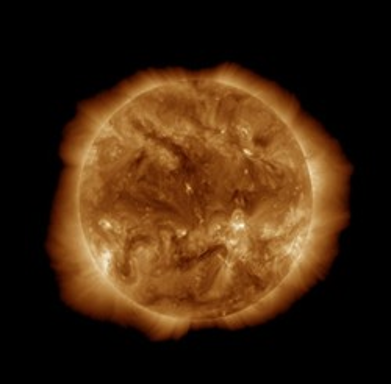
This Solar Dynamics Observatory Image was taken on April 21, 2022. [Photo courtesy of NASA SDO/HMI]

Solar flares emerged daily over the last reporting week. On April 20, 2022, Spaceweather.com reported “Solar Activity is Intensifying,” and over the past 24 hours, there were 19 solar flares, including six M-class events, and a powerful X2.2-class solar flare.

Daily sunspot numbers averaged 64.4, 30 points higher than last week, and average daily solar flux also rose 30 points from 103.1 to 133.1.

Even with all flares and coronal mass ejections (CMEs), geomagnetic indicators were lower, with average planetary A index going from 16.9 to 14.6, and middle latitude numbers dropping from 12.6 to 10.9.

Predicted solar flux looks moderate, at 130 on April 21 – 27; 132 on April 28; 125 on April 29 – 30; 130 on May 1 – 4; 125 on May 5; 130 on May 6 – 7; 128 on May 8; 130 on May 9 – 10; 135 on May 11 – 12; 140 on May 13 – 14; 135 on May 15; 130 on May 16 -18; 135 on May 19; 130 on May 20 – 21; 135 on May 22, and 132 on May 23 – 25.

Predicted planetary A index is 5 on April 21 – 22; 12 on April 23; 8 on April 24 – 26; 5 on April 27 – 28; 18, 12, and 8 on April 29 – May 1; 5 on May 2 – 5; 8, 15, 12, and 8 on May 6 – 9; 5 on May 10 – 12; 8, 10, and 12 on May 13 – 15; 10 on May 15 – 17; 8 on May 18 – 19; 12 and 8 on May 20 – 21, and 5 on May 22 – 25. Sunspot numbers for April 14 – 20 were 37, 35, 78, 74, 79, 68, and 80, with a mean of 64.4. The 10.7-centimeter flux was 103.4, 110.3, 122.4, 134.9, 140.5, 160.1, and 160, with a mean of 133.1. Estimated planetary A indices were 38, 21, 8, 11, 8, 7, and 9, with a mean of 14.6. Middle latitude A index was 22, 14, 7, 9, 7, 8, and 9, with a mean of 10.9

4-14-22 Solar Report

Tad Cook, K7RA, Seattle, Washington, reports:

At 0010 UTC on April 14, the Australian Space Forecast Centre issued

This Solar Dynamics Observatory Image was taken on April 14, 2022. [Photo courtesy of NASA SDO/HMI]

a Geomagnetic Disturbance Warning that stated, “Increased geomagnetic activity expected due to coronal mass ejection from April 14 – 15 2022.”

Sunspot numbers and solar flux declined this reporting week (April 7 -13), although solar activity was not really down, Instead, there were solar flares and coronal mass ejections (CMEs) every day, causing disruptions to HF radio communication.

There was a new sunspot appearance on April 7, and another on each day from April 11 – 13. Yet, average daily sunspot numbers declined from 94.6 to 34.4, and average daily solar flux dropped from 135.3 to 103.1.

Average daily planetary A index increased from 14.4 to 15.9. Average middle latitude A index, measured at a single magnetometer in Virginia, went from 10.9 last week to 12.6 this week.

The latest solar flux prediction from the US Air Force Space Weather Squadron, via he National Oceanic and Atmospheric Administration (NOAA), shows modest activity for the next month at 100, 103, 105, and 106 on April 14 – 17; 105 on April 18 – 19; 108 and 106 on April 20 – 21; 110 on April 22 – 23; 115 on April 24; 118 on April 25 – 28; 116 on April 29 through May 6; 112 and 98 on May 7- 8; 95 on May 9 – 11; 98 and 102 on May 12 – 13, and 106 on May 14 – 18.

Predicted planetary A index is 35, 20, 12, 8, and 5 on April 14 – 18; 10, 8, 10, 5, 15, 10, and 8 on April 19 – 25; 5 on April 26 – 28; 18, 12, and 8 on April 29 through May 1; 5 on May 2 – 5; 8, 15, and 12 on May 6 – 8; 5 on May 9 – 11; 12 and 8 on May 12 – 13; 5 on May 14 – 16, and 10 on May 17 – 18.

Sunspot numbers for April 7 – 13 were 52, 55, 37, 13, 24, 23, and 37, with a mean of 34.4. The 10.7-centimeter flux was 111.1, 108.9, 107.1, 101.1, 98.7, 96.2, and 98.7, with a mean of 103.1. Estimated planetary A indices were 15, 9, 19, 34, 13, 12, and 9, with a mean of 15.9. Middle latitude A index was 12, 9, 17, 18, 13, 10, and 9, with a mean of 12.6.

Solar Report 4-8-22

Tad Cook, K7RA, Seattle, Washington, reports:

New sunspot groups appeared on March 31, April 1, April 2, April 3, and April 5. This Solar Dynamics Observatory (SDO) image was taken on April 7, 2022. [NASA SDO/HMI photo]

A lot of solar activity livened up HF conditions over the past reporting week, March 31 to April 6. Average daily sunspot number rose from 90.1 to 94.6, and daily solar flux from 132.7 to 135.3.

A new sunspot group appeared on March 31, two more on April 1, another on April 2, one more on April 3, and another on April 5.

Predicted solar flux is 116, 115, 118, 112, and 110 on April 7 – 11, 108 on April 12 – 14, 120 on April 15 – 17, 125 on April 18 – 19, 130 on April 20 – 23, 140 on April 24 – 28, 135 on April 29 – 30, 130 on May 1, 120 on May 2 – 3, 125 on May 4 – 5, 120 on May 6, 115 on May 7 – 8, and 110 on May 8 – 9.

Predicted planetary A index is 25, 12, 15, 10, and 8 on April 7 – 11; 5 on April 12 – 19; 10 on April 29 – 21; 5, 15, 10, and 8 on April 22 – 25; 5 on April 26 – 28; 18, 12, 10, and 8 on April 29 through May 2; 5 on May 3 – 7, and 12 and 10 on May 8 – 9.

Sunspot numbers for March 31 through April 6, 2022 were 84, 109, 118, 129, 86, 75, and 61, with a mean of 94.6. The 10.7-centimeter flux was 149, 3, 146.6, 143.3, 140.2, 128, 122.4, and 117, with a mean of 135.3. Estimated planetary A indices were 27, 17, 22, 10, 11, 6, and 8, with a mean of 14.4. Middle latitude A index was 18, 12, 19, 7, 8, 6, and 6, with a mean of 10.9.

A comprehensive K7RA Solar Update is posted Fridays on the ARRL website. For more information concerning radio propagation, visit the ARRL Technical Information Service, read “What the Numbers Mean…,” and check out the Propagation Page of Carl Luetzelschwab, K9LA.

A propagation bulletin archive is available. For customizable propagation charts, visit the VOACAP Online for Ham Radio website.

Share your reports and observations.
Informational Net Ends

On May 1.2022 the Sunday night informational net will come to an end for the late Spring, Summer and early Fall months. Continue to watch this site for any updates to the repeater system. Hope you all have a great and enjoyable summer months and will see you again next Fall.

The K7RA Solar Update

Tad Cook, K7RA, Seattle, reports:

Many solar flares and CMEs occurred over the reporting week (March 24 – 30) but with glancing blows and near misses it wasn’t reflected in the geomagnetic indicators. The Planetary A index reached a high for the week of 19 on March 27. Average daily planetary A index rose by a modest amount from 6.3 to 10.

Average daily sunspot number rose from 33.4 to 80.1, while solar flux went from 99.9 to 132.7.

Predicted solar flux is forecast to be 150 on March 31 and April 1, then 145, 130, 125, 120, and 115 on April 2 – 6, 118 on April 7 – 9, then 115 and 110 on April 10 – 11, 105 on April 12 – 14, 108 on April 15, 105 on April 16 – 19, 110 on April 20 – 21, 115 on April 22, 125 on April 23 – 26, then 123, 118 and 118 on April 27 – 29, and 108 on April 30 through May 2.

On Wednesday, March 30, local news in Seattle was telling viewers that if only we had clear skies, we could see aurora tonight or tomorrow. This is likely with the predicted Planetary A index at 58 and 32 on March 31 and April 1, then 10, 12 and 10 on April 2 – 4, 8 on April 5 – 6, then 5 and quieter conditions on April 7 – 19, 10 on April 20 – 21, then 5, 15, and 10 on April 22 – 24, 5 on April 25 – 29, and 12, and 8 on April 30 and May 1.

We’ve been seeing more activity on 10 meters over the past week. Check it out.

Sunspot numbers for March 24 – 30, 2022, were 44, 50, 48, 97, 125, 124, and 73, with a mean of 80.1. 10.7-centimeter flux was 112, 112, 119, 130, 156, 149, and 151, with a mean of 132.7. Estimated Planetary A indices were 9, 10, 7, 18, 10, 8, and 8, with a mean of 10. Middle latitude A index was 6, 3, 6, 11, 4, 7, and 6, with a mean of 8.1

A comprehensive K7RA Solar Update is posted Fridays on the ARRL website. For more information concerning radio propagation, visit the ARRL Technical Information Service, read “What the Numbers Mean…,” and check out the Propagation Page of Carl Luetzelschwab, K9LA.

A propagation bulletin archive is available. For customizable propagation charts, visit the VOACAP Online for Ham Radio website.

Share your reports and observations.

New Amateur Radio License Applications Fee To Become Effective April 19, 2022

A Public Notice released by the Federal Communications Commission (FCC) on March 23, 2022, in MD Docket No. 20-270, announced that new application fees for Wireless Telecommunications Bureau applications will become effective on April 19, 2022. The new fees, mandated by Congress, apply to applications for Amateur Radio licenses including those associated with filing Form 605, the Amateur Operator/Primary Station Licensee Application.

Effective April 19, 2022, a $35 fee will apply to applications for a new Amateur Radio license, modification (upgrade and sequential call sign change), renewal, and vanity call signs.

Anticipating the implementation of the fee in 2022, the ARRL Board of Directors, at its July 2021 meeting, approved the “ARRL Youth Licensing Grant Program.” Under the program, ARRL will cover a one-time $35 application fee for license candidates younger than 18 years old for tests administered under the auspices of the ARRL Volunteer Examiner Coordinator (ARRL VEC). Qualified candidates also would pay a reduced exam session fee of $5 to the ARRL VEC. ARRL is finalizing details for administering the program.

ARRL had filed comments in opposition to imposing a fee on Amateur Radio license applications. The FCC initially proposed a higher, $50 fee. In a Report and Order (R&O), released on December 29, 2020, the amount was reduced — the FCC agreeing with ARRL and other commenters that its proposed $50 fee for certain amateur radio applications was “too high to account for the minimal staff involvement in these applications.”

ARRL Volunteer Examiner Coordinator (ARRL VEC) Manager Maria Somma, AB1FM, explained that all fees are per application. “There will be no fee for administrative updates, such as a change of mailing or email address. The fees will be the responsibility of the applicant regardless of filing method and must be paid within 10 calendar days of FCC’s receipt of the application. For applications filed by a VEC, the period does not begin until the application is received by the Commission, a ULS file number assigned, and an email sent by the FCC directly to the applicant.”

VECs and Volunteer Examiner (VE) teams will not collect the $35 fee at license exam sessions. New and upgrade candidates at an exam session will continue to pay the $15 exam session fee to the ARRL VE team as usual, and pay the new, $35 application fee directly to the FCC by using the CORES FRN Registration system (CORES – Login).

When the FCC receives the examination information from the VEC, it will email a link with payment instructions to each successful candidate who then will have 10 calendar days from the date of the email to pay. After the fee is paid and the FCC has processed an application, examinees will receive a second email from the FCC with a link to their official license or explanation of other action. The link will be good for 30 days.

Somma also explained that applications that are processed and dismissed will not be entitled to a refund. This includes vanity call sign requests where the applicant does not receive the requested call sign. “The FCC staff has suggested that applicants for vanity call signs should first ensure the call signs requested are available and eligible for their operator class and area, and then request as many call signs as the form allows to maximize their chances of receiving a call sign.”

Further information and instructions about the FCC Application Fee are available from the ARRL VEC at www.arrl.org/fcc-application-fee. Details for the ARRL Youth Licensing Grant Program will be similarly posted there, when available.

St. Patrick’s Day Report

Tad Cook, K7RA, Seattle, Washington reports: On March 11 at 0431 UTC, Australia’s Space Forecast Centre issued a warning. “A slow coronal mass ejection has been observed late on 10 March, and event modeling suggests arrival at the Earth late on 13 March. Increased geomagnetic activity is expected for 14 March 2022.”

We observed an active sun this week. Geomagnetic indicators peaked on Saturday, March 5, when Alaska’s high-latitude college A index reached 42.

Again this week, sunspots covered the sun every day. Average daily sunspot numbers rose from 44 to 87.4, and average daily solar flux went from 98.5 to 115.5. Geomagnetic indicators were also higher. Average daily planetary A index increased from 7.3 to 11.4.

The vernal equinox is in a little over a week, 1533 UTC on Sunday, March 20, when Earth will be bathed in an equal amount of solar radiation over both Southern and Northern Hemispheres, good for HF propagation. It is the first day of spring in the Northern Hemisphere, and fall in the southern.

Predicted solar flux is 120 on March 11 – 12; 115 on March 13; 110 on March 14 – 16; 105 on March 17; 100 on March 18 – 21; then 101 and 103 on March 22 – 23; 104 on March 24 – 27; then 110, 115, and 116 on March 28 – 30; 118 on March 31 through April 1; 120 on April 2; 116 on April 3 – 4; then 115 and 112 on April 5 – 6; 110 on April 7 – 9; then 108, 102, 98, and 99 on April 10 – 13; then 100 on April 14 – 17.

Predicted planetary A index is 12 on March 11; 5 on March 12 – 13; then 10, 18, 15, 5, and 8 on March 14 – 18; then 12 on March 19 – 20; 15 on March 21; 7 on March 22 – 24; then 5, 10 and 8, on March 25 – 27; 5 on March 28 – 29; then 10, 12, 25, 20, and 10 on March 30 through April 3; 5 on April 4 – 6; then 15, 20, and 12 on April 7 – 9; 5 on April 10 – 13; then 8 on April 14, and 10 on April 15 – 16.

Sunspot numbers for March 3 through 9, 2022 were 92, 77, 95, 82, 84, 93, and 89, with a mean of 87.4. 10.7-centimeter flux was 110.9, 113.1, 120.1, 115.7, 118.3, 115.3, and 114.8, with a mean of 115.5. Estimated planetary A indices were 5, 10, 27, 18, 9, 6, and 5, with a mean of 11.4. Middle latitude A index was 3, 7, 19, 13, 7, 5, and 4, with a mean of 8.3.

A comprehensive K7RA Solar Update is posted Fridays on the ARRL website. For more information concerning radio propagation, visit the ARRL Technical Information Service, read “What the Numbers Mean…,” and check out the Propagation Page of Carl Luetzelschwab, K9LA.

A propagation bulletin archive is available. For customizable propagation charts, visit the VOACAP Online for Ham Radio website.

Share your reports and observations.

Solar Report 3/10/22

Tad Cook, K7RA, Seattle, reports: We watched an active sun this week. Geomagnetic indicators peaked on Saturday, March 5, when Alaska’s high latitude college A index reached 42.

Again this week, sunspots covered the sun each day. Average daily sunspot numbers rose from 44 to 87.4, and average daily solar flux went from 98.5 to 115.5. Geomagnetic indicators were also higher. Average daily planetary A index increased from 7.3 to 11.4.

Predicted solar flux is 115 and 114 on March 10 – 11; 112 on March 12 – 14; 110 on March 15 – 16; 99 on March 17; 100 on March 18 – 21; 101 and 103 on March 22 – 23; 104 on March 24 – 27; 110, 115, and 116 on March 28 – 30; 118 on March 31 – April 1; 120 on April 2; 116 on April 3 – 4; 115 and 112 on April 5 – 6; 110 on April 7 – 9, and 108, 102, 98 and 99 on April 10 – 13.

Predicted planetary A index is 12 on March 10 – 11; 5 on March 12 – 14; 8 on March 15 – 16; 5 and 8 on March 17 – 18; 12 on March 19 – 20; 15 on March 21; 7 on March 22 – 24; 5, 10, and 8 on March 25 – 27; 5 on March 28 – 29; 10, 12, 25, 20, and 10 on March 30 – April 3; 5 on April 4 – 6; 15, 20, and 12 on April 7 – 9, and 5 on April 10 – 13.

Sunspot numbers for March 3 – 9 were 92, 77, 95, 82, 84, 93, and 89, with a mean of 87.4. The 10.7-centimeter flux was 110.9, 113.1, 120.1, 115.7, 118.3, 115.3, and 114.8, with a mean of 115.5. Estimated planetary A indices were 5, 10, 27, 18, 9, 6, and 5, with a mean of 11.4. Middle latitude A index was 3, 7, 19, 13, 7, 5, and 4, with a mean of 8.3.

A comprehensive K7RA Solar Update is posted Fridays on the ARRL website. For more information concerning radio propagation, visit the ARRL Technical Information Service, read “What the Numbers Mean…,” and check out the Propagation Page of Carl Luetzelschwab, K9LA