K7RA Solar report

The K7RA Solar Update

Tad Cook, K7RA, Seattle, reports: New sunspots appeared on November 14 and 16, but solar activity was lower, and geomagnetic activity was lower as well.

Average daily sunspot numbers declined from 36.4 last week to 30.9 in the November 11 – 17 reporting week. Solar flux averages were off as well, dipping to to 80.8 this week compared to 89.1 last week.

Average daily planetary A index declined from 18 to 7, and average middle latitude numbers went from 11.7 to 4.9. Middle latitude A index daily average went all the way down to zero on November 13.

We see no high numbers in the solar flux prediction, which has 78 on November 18 – 20; 80 on November 21 – 24; 83 on November 25; 85 on November 26 – 27; 83 on November 28 – 29; 85 on November 30 – December 2; 82 on December 3 – 11; 79, 80, and 79 on December 12 – 14; 78, 77, 79, and 81 on December 15 – 18; 83 on December 19 – 21, and 85 on December 22 – 24.

Predicted planetary A index is a quiet 5 on November 18 – 20; then 12 and 8 on November 21 – 22; 5 on November 23 – 27; 10, 10, and 8 on November 28 – 30; 5 on December 1 – 12; 12 on December 13 – 14, and back to 5 on December 15 – 24.

Sunspot numbers for November 11 – 17 were 39, 39, 24, 23, 23, 35, and 33, with a mean of 30.9. The 10.7-centimeter flux was 84.5, 82.9, 81, 78.7, 79.3, 80.1, and 79.2, with a mean of 80.8. Estimated planetary A indices were 4, 4, 3, 4, 9, 13, and 12, with a mean of 7. Middle latitude A index was 3, 3, 0, 2, 6, 11, and 9, with a mean of 4.9.

A comprehensive K7RA Solar Update is posted Fridays on the ARRL website. For more information concerning radio propagation, visit the ARRL Technical Information Service, read “What the Numbers Mean…,” and check out the Propagation Page of Carl Luetzelschwab, K9LA. A propagation bulletin archive is available. For customizable propagation charts, visit the VOACAP Online for Ham Radio website
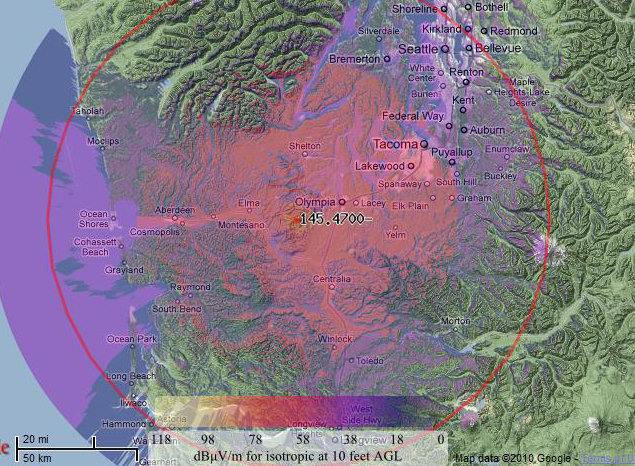
Coverage Map

The NET is returning

Beginning Sunday Nov. 7th the weekly Sunday night informational net will be held. If you are a licensed amateur radio operator please tune in to 145.47 and participate. Discussion will be held as to the current operation of the repeater and other repeater activities. Tune in at 8:00 pm. See you on the net!

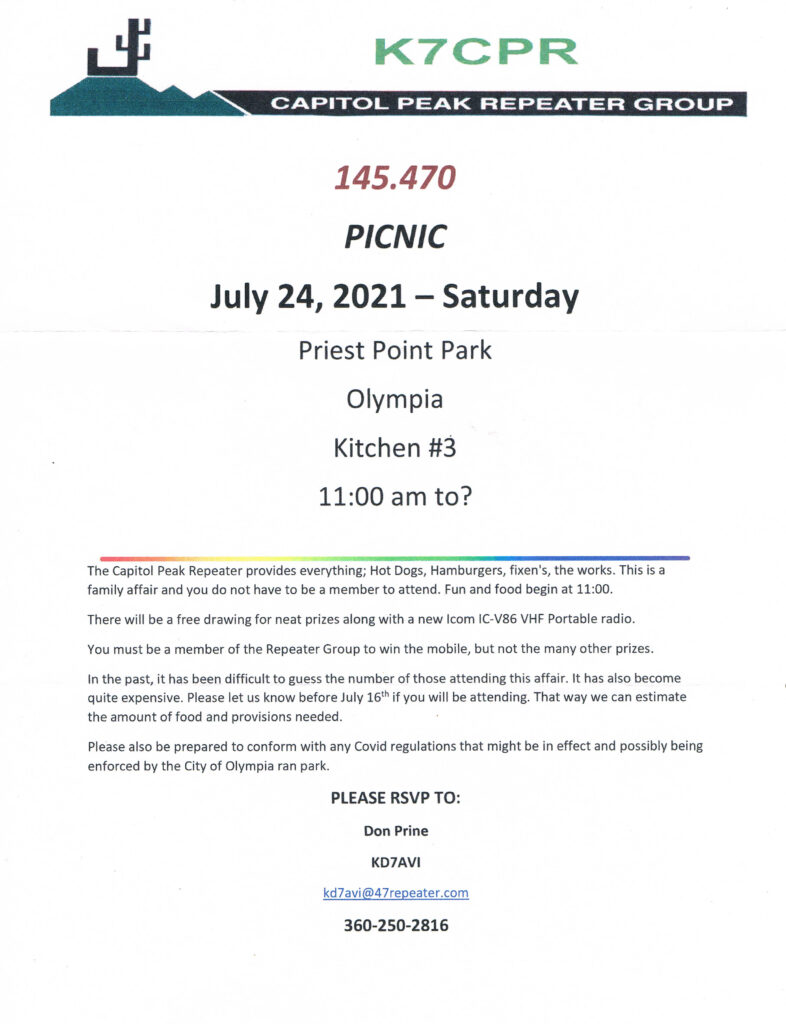
2021 Picnic

First-Time Exam Applicants Must Obtain FCC Registration Number before Taking Exam

Beginning May 20, 2021, all amateur examination applicants will be required to provide an FCC Registration Number (FRN) to the Volunteer Examiners (VEs) before taking an amateur exam. This is necessary due to changes the FCC has made to its licensing system.Amateur candidates who already have an FCC license, whether for amateur radio or in another service, already have an FRN and can use the same number. All prospective new FCC licensees, however, will be required to obtain an FRN before the examination and provide that number to the volunteer examiners on the Form 605 license application. An FCC instructional video provides step-by-step instructions on how to obtain an FRN through the FCC’s COmmission REgistration System (CORES).The FRN is required for all new applicants to take an amateur exam and is used afterward by the applicant to download the license document from the FCC Universal Licensing System (ULS), upgrade the license, apply for a vanity call sign, and to submit administrative updates (such as address and email changes) and renewal applications.In addition, after June 29, all applications will be required to contain an email address for FCC correspondence. Applicants will receive an email direct from the FCC with a link to the official electronic copy of their license whenever a license is issued or changed. ARRL VEC suggests that those without access to email to use the email address of a family member or friend. Licensees will be able to log in to the ULS using their FRN and password to download the latest version of their license at any time. The FCC no longer provides paper license documents.